
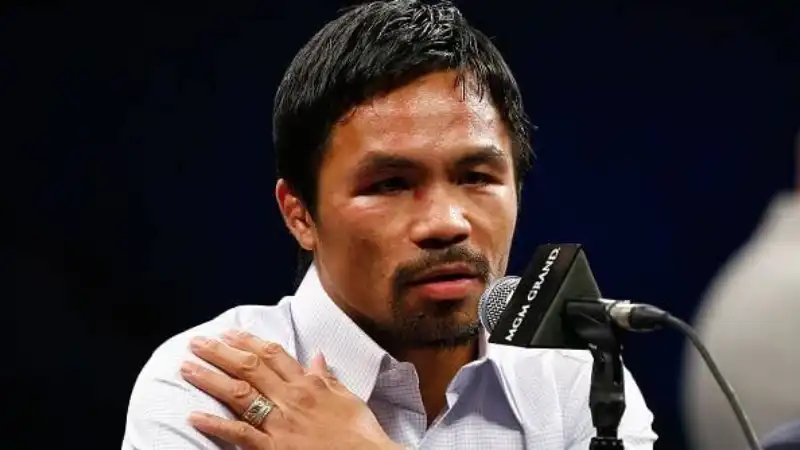
Manny Pacquiao is one of the most recognisable figures in modern boxing and one of the most successful athletes ever to emerge from the Philippines. Known around the world as “Pac-Man”, he built an extraordinary career from extremely difficult beginnings, eventually becoming the first and only boxer to win world championships across eight weight divisions. Guinness World Records officially recognises his eight-division achievement.
Beyond boxing, Pacquiao became a politician, businessman, entertainer and philanthropist. He served in the Philippine House of Representatives before winning a Senate seat in 2016. He also became an international commercial star, with major endorsement partnerships and enormous pay-per-view audiences contributing to his fortune.
For readers searching, however, one point needs to be made clear: there is no independently audited public figure for his personal net worth. Widely cited estimates put his wealth at approximately US$220 million, while his career earnings from boxing and endorsements have been estimated at considerably more. Those figures are not interchangeable. Career earnings represent money generated over decades; net worth reflects what remains after taxes, spending, investments, business activity and other financial obligations.
Here is a closer look at Pacquiao’s life, career, wealth and lasting influence.
Early Life and Family Background
Emmanuel Dapidran Pacquiao was born on 17 December 1978 in Kibawe, Bukidnon, Philippines. He grew up in poverty in Mindanao, where financial hardship shaped much of his childhood and later became a central part of his public story.
Pacquiao has spoken openly about experiencing hunger and working from a very young age to help his family. In a speech at Oxford in 2018, he described having to work from the age of five and recalled days when he had little or no food. He eventually left formal secondary schooling because his family needed financial support.
As a teenager, Pacquiao moved towards Manila in search of opportunity. Boxing offered something that conventional employment could not: a chance to turn physical ability and determination into an income.
That decision changed the course of his life.
Education
Pacquiao’s education followed an unusual path because poverty interrupted his formal schooling.
He completed his primary education at Saavedra Saway Elementary School in General Santos City but did not complete high school through the conventional route. In 2007, he passed the Philippine Department of Education’s accreditation and equivalency examination through the Alternative Learning System, allowing him to obtain a high-school qualification.
His interest in education did not stop there. He enrolled in business management studies at Notre Dame of Dadiangas University in 2008, although he did not initially complete that course. Later, while serving in politics, he returned to university.
In December 2019, at the age of 40, Pacquiao graduated from the University of Makati with a Bachelor of Arts in Political Science, majoring in Local Government Administration.
Claims that he completed the degree in only three months are misleading. Fact-checking organisations reported that he completed the programme over approximately 16 months, beginning in 2018, through the university’s College of Continuing, Advanced and Professional Studies. His professional and government experience counted towards the programme’s academic requirements.
Pacquiao later continued his education and, according to profiles of his career, completed a master’s degree in management with a specialisation in public administration at Philippine Christian University in 2022.
His educational journey is significant because it demonstrates that his development did not stop once he became a world champion. He used alternative education and later university study to strengthen his preparation for public life.
Career Beginnings: From Poverty to Professional Boxing
Pacquiao turned professional in 1995, when he was only 16. His early career looked nothing like the multimillion-pound and multimillion-dollar boxing world that would eventually surround him.
He spent years fighting on relatively small cards in the Philippines, often for modest purses. Forbes reported that Pacquiao received just US$20 for his first professional fight, illustrating the enormous distance between his beginnings and his later earnings.
His breakthrough arrived in 1998, when he defeated Thailand’s Chatchai Sasakul to win the WBC flyweight title. At 19, Pacquiao had secured his first major world championship.
The victory established him as a serious international prospect, but the biggest transformation was still ahead.
Rise to Global Fame
Pacquiao’s career accelerated after he began competing in the United States. In 2001, he defeated Lehlo Ledwaba to win the IBF super-bantamweight championship, a victory that introduced him to a much wider American audience.
His rivalry with Mexican legend Juan Manuel Márquez and victories over elite fighters such as Erik Morales and Marco Antonio Barrera helped establish him as one of boxing’s premier attractions.
Then came the defining turning point: his victory over Oscar De La Hoya in December 2008.
Pacquiao entered that bout as the smaller man but dominated De La Hoya before the fight was stopped. Forbes reported that the contest generated 1.25 million pay-per-view buys, while Pacquiao earned approximately US$15 million.
That performance transformed Pacquiao from a hugely successful fighter into a global sporting celebrity.
His 2009 victory over Ricky Hatton further strengthened his reputation. Pacquiao stopped Hatton in the second round and captured another major title. TIME noted that the victory made him a world champion in a sixth weight division at the time.
He subsequently defeated Miguel Cotto, Antonio Margarito, Shane Mosley and other elite opponents, continuing his remarkable climb through the weight classes.
The Eight-Division Championship Record
The defining achievement of Manny Pacquiao’s boxing career came in November 2010.
He defeated Antonio Margarito to win the WBC super-welterweight championship, becoming the first boxer in history to win recognised world titles in eight different weight divisions. Guinness World Records lists the achievement as an official record.
This feat matters because boxers normally struggle to remain competitive when moving between weight classes. Pacquiao repeatedly moved upwards against naturally larger opponents while maintaining elite speed, power and stamina.
His career ultimately produced 12 major world titles across eight divisions, according to the Philippine Senate and boxing authorities.
His professional record at the conclusion of his 2021 retirement stood at 62 wins, eight defeats and two draws, with 39 victories by knockout.
The Floyd Mayweather Fight and Its Financial Impact
No discussion of Manny Pacquiao’s wealth is complete without the 2015 fight against Floyd Mayweather Jr.
The bout, held in Las Vegas on 2 May 2015, became one of the biggest commercial events in boxing history. Forbes reported 4.6 million pay-per-view buys and approximately US$600 million in total event revenue. Pacquiao’s share was estimated at roughly US$120–125 million.
The fight also helped explain why estimates of Pacquiao’s wealth vary so dramatically.
Forbes estimated that Pacquiao’s career earnings had reached roughly US$500 million by 2016, while a later Forbes ranking put his career earnings at approximately US$510 million in 2017.
Those figures include earnings rather than personal net worth. Therefore, it would be inaccurate to state that Pacquiao’s net worth simply equals his lifetime boxing income.
Manny Pacquiao Net Worth</h2>
So, how much is Manny Pacquiao worth?
The most frequently cited modern estimate is approximately US$220 million. Celebrity Net Worth currently gives that figure, and Sporting News repeated the estimate in its coverage of Pacquiao’s finances.
However, this should be treated as an estimate rather than a confirmed balance sheet.
Pacquiao’s wealth has been built through several channels:
- Professional boxing purses
- Pay-per-view revenue
- Sponsorships and endorsements
- Television and commercial rights
- Business interests
- Real estate and other investments
- Entertainment projects
- Sports-related ventures
His boxing income alone has been estimated at approximately US$575 million, although published figures differ depending on whether they include endorsements, exhibitions, inflation adjustments, and revenue shares. Sporting News reported the US$575 million estimate in 2025.
The Ring reported in July 2025 that Pacquiao had already accumulated more than US$550 million in career earnings, further illustrating the scale of his financial success.
His return to professional boxing in July 2025, against Mario Barrios, reportedly generated a guaranteed purse of around US$12 million, with the potential to rise substantially through additional revenue.
Pacquiao and Barrios fought to a majority draw at the MGM Grand Garden Arena in Las Vegas. The comeback showed that, even after several years away from professional boxing, Pacquiao remained an enormous commercial attraction.
Why His Net Worth Is Lower Than His Career Earnings
This distinction is important for anyone researching Manny Pacquiao’s wealth.
A fighter can generate hundreds of millions of dollars without retaining the same amount as personal wealth. Taxes, management fees, training expenses, promoters, business investments, charitable giving and personal expenditure can substantially reduce accumulated assets.
Pacquiao has also maintained a broad public and business profile rather than relying exclusively on boxing income.
For this reason, US$220 million is best described as a widely reported estimated net worth, not a verified figure. Readers should be cautious with websites claiming an exact figure without explaining how they calculated it.
Political Career and Public Service
Pacquiao’s influence expanded beyond sport when he entered Philippine politics.
After losing his first congressional campaign in 2007, he returned to politics and won a seat representing Sarangani in 2010. He won re-election in 2013 before being elected to the Philippine Senate in 2016.
His political career was controversial at times, as is common with high-profile public figures, but it demonstrated the extraordinary level of trust and recognition he had built among many Filipinos.
The Philippine Senate has highlighted his background as a former child worker who rose from poverty and later entered public service. It also records his involvement in legislation and advocacy relating to national athletes and other social issues.
Pacquiao’s political career also reinforced an important aspect of his public identity: he became more than a sportsman. For many supporters, his story represented social mobility and national pride.
Personal Life
Pacquiao married Jinkee Pacquiao in 1999. The couple has five children. Jinkee has also pursued public and business activities, including serving as vice governor of Sarangani from 2013 to 2016.
Family has remained a recurring theme in Pacquiao’s public story. His rise from poverty allowed him to provide opportunities for his family, while several members have developed careers in politics, entertainment, business and sport.
Pacquiao has also pursued interests outside boxing, including acting and music. Biography.com notes that he released music and appeared in films and television, including the sitcom Show Me Da Manny. A documentary titled Manny was released internationally in 2015.
Major Awards and Recognition
Pacquiao’s achievements have attracted recognition from sporting organisations and institutions around the world.
Among his most important honours are:
- Eight-division world champion, a Guinness World Records-recognised achievement.
- Boxing Writers Association of America Fighter of the Decade for the 2000s.
- Multiple Fighter of the Year awards from organisations including the BWAA, ESPN and The Ring.
- TIME 100 recognition in 2009 as one of the world’s most influential people.
- International Boxing Hall of Fame Class of 2025.
His 2025 Hall of Fame induction provided perhaps the clearest institutional recognition of his overall boxing legacy.
The International Boxing Hall of Fame described him as boxing’s only eight-division champion and inducted him alongside other notable fighters in June 2025.
Interesting Facts About Manny Pacquiao
Several details help explain why Pacquiao remains such a distinctive sporting figure.
He started professional boxing at 16. His first professional years were spent fighting for very small purses before he became an international star.
He won titles across eight weight divisions. No other boxer has matched this particular championship achievement.
He became the oldest welterweight world champion. In July 2019, at age 40, Pacquiao defeated Keith Thurman to win the WBA super welterweight title.
He became a senator while still competing professionally. His political and boxing careers overlapped for years.
He returned to professional boxing in 2025. After retiring in 2021, Pacquiao fought Mario Barrios to a majority draw in July 2025.
His proposed 2026 Mayweather rematch became uncertain. A rematch with Floyd Mayweather had been planned for September 2026, but reports in June 2026 said the event had been postponed indefinitely because of legal and scheduling complications.
Legacy and Influence
Manny Pacquiao’s legacy goes well beyond his collection of championship belts.
First, he changed perceptions of what a boxer could achieve across weight divisions. His ability to move from the lighter categories into the welterweight and super-welterweight ranks challenged conventional expectations about size and athletic longevity.
Second, he helped globalise boxing’s commercial appeal. His biggest fights regularly generated enormous pay-per-view audiences, while his rivalry with Mayweather produced one of the most financially significant events in combat-sports history. Forbes reported that Pacquiao’s pay-per-view career had generated billions of dollars in event revenue.
Third, his story has powerful cultural significance in the Philippines. TIME described the connection between Pacquiao and Filipino fans as exceptionally strong, noting how his achievements became a source of national pride.
Finally, his journey illustrates how sport can provide a route out of poverty and into broader social influence. Pacquiao did not simply become wealthy through boxing; he transformed sporting fame into political influence, commercial opportunities, educational achievement and an enduring public identity.
Conclusion
The story behind Manny Pacquiao’s net worth is ultimately much bigger than a single dollar figure.
Pacquiao began life in severe poverty, left conventional education because of financial hardship and entered professional boxing as a teenager. Over the following decades, he became an eight-division world champion, a global pay-per-view star, a politician, businessman and internationally recognised personality.
His career earnings have been estimated at hundreds of millions of dollars, with Forbes previously placing his cumulative earnings around US$500 million and later reporting approximately US$510 million by 2017. More recent reporting has put his lifetime boxing earnings at roughly US$575 million.
Meanwhile, the most commonly cited estimate of his current net worth is around US$220 million. Because Pacquiao’s complete financial records are not publicly audited, that number should be regarded as an estimate rather than an exact measurement of his wealth.
What is far less debatable is his sporting legacy. With eight world championship divisions, 12 major world titles, a Hall of Fame induction and a career spanning more than two decades, Manny Pacquiao occupies a unique place in boxing history.
His greatest achievement may therefore not be the fortune he accumulated, but the distance he travelled to build it — from a struggling child in the Philippines to one of the most influential and commercially successful fighters the sport has ever produced. For more information, visit our site daily.